
Being an engineering student myself, I already know of quite a few artifacts that can be found in the depths of Stocker's lower level. Last winter, I had the delightful experience of being able to take a metal machining class, ETM 117. ETM 117 was an excellent class that anyone who believes they will be working in a manufacturing environment should take. Engineers need to be able to use these machines for a few reasons. They need to know the abilities and limitaions of the machines so that when designing a part or process for a part, they can know whether or not it is even possible to manufacture. It is also necessary to know how to use the machine in case the engineer needs to use the machine to make a part on their own. In the class, we used all sorts of machines, but the one that we used the most was the Turnmaster Lathe.

Turnmaster Lathe similar to the one used by ME students
The lathe is a machine used for forming a rod of material into a usuable shape. In our case, we made a screw for the vise we made. Using the lathe, there are many operations that a machinist can do. The first thing we learned was facing off the end of a rod. This is done to create a smooth surface on the end of the rod because when the rod is cut on a bandsaw, the surface finish that is left is very poor. This operation is done with a high speed steel or carbide turning tool. Another operation that can be done is called turning a rod. This is done to decrease the diameter of the rod and is also done using either a high speed steel or carbide turning tool.

Two different types of carbide turning tools
Another primary operation on the lathe is threading. this operation creates the grooves on the rod to allow it to be screwed into a hole of matching size. Threading is also one of the most complicated operations on thelathe because of the timing involved. If one mistake is made, the machinist will have to start completely over.
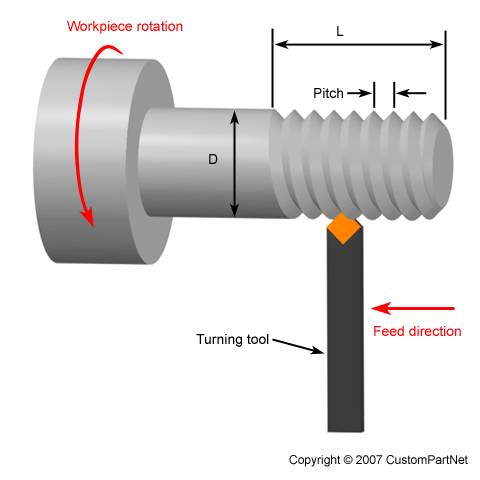
Threading operation.This operation is actually done with a threading tool (which comes to a very sharp point), not a turning tool.
Drilling can also be done with a lathe to create holes, counter bores, or counter sinks in the end of a rod. This is done using the so called "tail stock" of the lathe.The tail stock is used by putting a drill bit into it, and slowly driving the drill bit into the end of the workpiece as it is rotating. A decent amount of oil is required to lubricate the bit to keep it and the workpiece cool.

Tail stock of a lathe.
These are only a few of many operations that can be done on a lathe. The lathe is an effective machine that has, in part, driven manufacturing. The maunal lathe that was discussed in this post is starting to become more and more rare to CNC turning centers. These machines do all the work for the machinist. That is, all he has to do is locate the part in the machine, push a button, and a program tells the center what tool to use and where. They operate much more quickly and efficiently than manual lathes. In ETM 117, we were also able to use a CNC turning center to create guide pins for the vise. The machine could make the part in less than a minute. The vise screw we made on the manual lathe took 5 weeks to complete.

Mazak turning center
Well thats all I've got on lathes, but if you have any questions I'd be happy to give a shot at answering them.

Yo Rob, this is all quality info on lathes man. I think it shows a glimpse of work that engineers can potentially be doing on a day to day bases. Its also cool to show this because people may not think machinist when they hear the work "engineer"...... Oh, and I just wanted you to know that you are the man. I didn't know if you knew that already or not.
ReplyDelete